Digital Skills
Introduction
Transcript
"Digital capability", "digital competency" and "digital literacy" are all popular terms for the same thing: being skilled at using a range of technologies that support living, learning and working in a digital society -- now and in the future. Digital skills include:
-
Using a computer
-
Communicating through online apps and other technologies
-
Performing a variety of tasks in digital environments
-
Using the internet and other digital technologies to find, evaluate, use or create information
-
Operating mobile devices of various kinds, such as phones or tablets
-
Being familiar with enough online tools to choose the right one to accomplish a given task
-
Understanding how to comply with the law in terms of copyright and intellectual property rights
Digital Skills for Educators
A good, comprehensive starting point for making sure you have the necessary digital skills for your teaching role is the EU's Digital Competence for Educators Framework (DigCompEdu), which spells out 22 competences in six areas. "The focus is not on technical skills. Rather, the framework aims to detail how digital technologies can be used to enhance and innovate education and training."
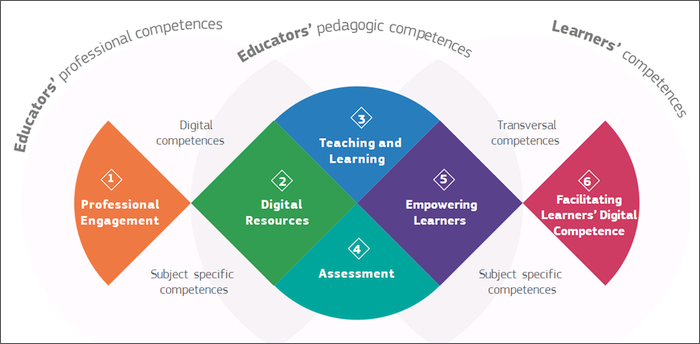
The six areas are:
- Professional Engagement: Using digital technologies for communication, collaboration and professional development
- Digital Resources: Sourcing, creating and sharing digital resources
- Teaching and Learning: Managing and orchestrating the use of digital technologies in teaching and learning
- Assessment: Using digital technologies and strategies to enhance assessment
- Empowering Learners: Using digital technologies to enhance inclusion, personalisation and learners’ active engagement
- Facilitating Learners’ Digital Competence: Enabling learners to creatively and responsibly use digital technologies for information, communication, content creation, wellbeing and problem-solving
You can download a pdf copy:

Teaching and Learning in a Digital Age
"E-Learning", "Online Learning", "Educational Technology", Learning Technology", and "Digital Learning" all refer to the use of digital technologies to deliver or enhance education. These days, the ubiquity of digital technologies in our everyday lives -- for communicating, navigating, reading, watching, shopping, and so on -- means that it's less of a novelty to teach and learn with them, and more of an anomaly to teach and learn without them.
In addition, digital technologies break down common barriers and offer a range of benefits to both students and teaching staff by allowing access to materials, assignments, classrooms, lectures, grades, feedback and contact outside of traditional hours and beyond geographical proximity. More students --and teachers -- in other locations and time zones can be "present" and involved in learning.
The challenge is that technologies, applications and systems change quickly, and expected skills, policies and practices that develop in one institution may not be exactly the same as another institution. A new member of staff must get up to speed quickly to understand how to function successfully in his or her new environment. The good news is that there are common underlying ideas and principles that, when understood, can make learning the specific apps or systems in use by an institution less confusing.
This course touches on all of these areas and aims to help you understand underlying ideas and offer guidance toward learning or improving the specific skills.
[ Add insititutional links, if appropriate ]