Creating and Curating Content
Once you have a course design and a toolkit of practical ideas at your disposal, you need to create the contents of your course.
Repurposing
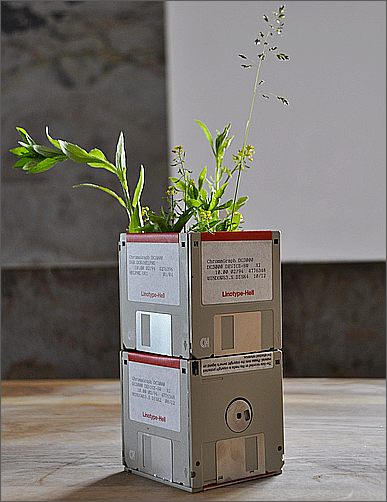
If you've been teaching a traditional F2F version of the course, you will have a range of materials, lecture notes, assignments and reading lists already to hand. This material is ripe for repurposing or re-use in new environments and new courses.
In the early days of online learning (c2000), the typical thing would be to transfer this material to pdfs and PowerPoint and upload onto web pages. While this is a convenient way to give students access to written materials (something novel and extremely valuable in 2000), simple access is no longer enough. Another way to look at this is "upcycling".
As technology has moved forward to allow us to provide rich and engaging online experiences, we have to be prepared to transition our old matierials into new and exciting learning opportunities. This may seem daunting, and to do it well does take a bit of time, but repurposing of content does not require special expertise, months of production or teams of developers.
As you will discover by exploring learning design tools and practical teaching courses, you can learn quick, simple and low-cost (or free) techniques to bring your old materials new life. The key is to become acquainted with a range of ideas and then go back to first principles to re-discover why you are teaching what you are teaching in order to decide how best to present that for optimum engagement: record yourself lecturing to camera? record your voice and place that over a video of images and diagrams? create a collaborative assignment / problem-based learning task? have students create online presentations? provide a range of resources linked together with readings? and so on.
New content
Curation
Curation of content simply refers to the process of choosing which resources and materials you will use in your course. Certainly you will select for relevance, reliability (truth) and quality, but you will also need to factor in Intellectual Property - your right to use the materials in the way you wish. As we explore elsewhere in this course, IP and copyright are not always clearly marked or understood.
The most dependable place to start is by searching for Open Educational Resources.
Open Educational Resources (OER) are any resources made freely available for educational use, such as courses, lectures, assignments, materials. The internet is crowded with resources -- some better than others -- which you can use to create or supplement the content for your teaching. There are also Open Access (OA) resources, such as journal articles, which are available for access but not necessarily repurposing.
Some useful guides and resources:
Some recent studies:
- Using learning design as a framework for supporting the design and reuse of OER
- Integration of good practices of active methodologies with the reuse of student-generated content
Co-creation
The co-creation of learning and student partnerships in learning fundamentally interrupt the traditional hierarchy and transmission model of learning as knowledge that comes from the teacher (higher) and flows to the students (lower). With co-creation, everyone pitches in together to create learning, and (ideally) everyone involved learns in the process, the teacher as well as the students.
While you could (co)build an entire curriculum alongside your students, you can also limit this radical approach to particular elements of a course or lesson: work together with your students to create (together) the content, approach, assessments (or any combination) around a theme or concept.
Co-creation of content has the additional benefit of establishing content for later instances of the course or module, which can stand as both valuable in its own right as well as providing a successful example of the process for future cohorts.
More information:
- Student engagement through partnership in higher education
- Co-creating Learning and Teaching: Towards relational pedagogy in higher education (2020)
[Link to local OER or other library guides and resources, if available]